Honolulu structures face intense rodent pressure fueled by distinct island microclimates. In wet valley zones like Manoa and Nuuanu, heavy rainfall drives arboreal roof rats down from dense mango and ironwood canopies…
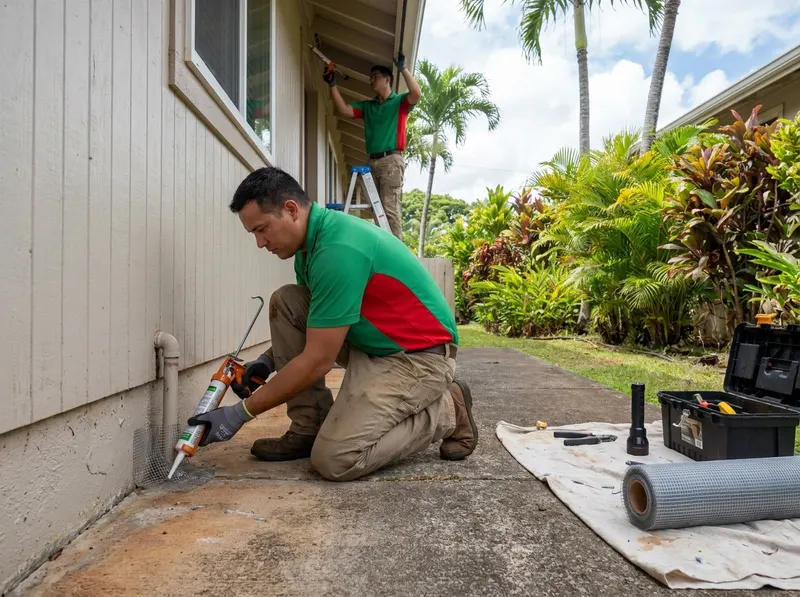
Honolulu structures face intense rodent pressure fueled by distinct island microclimates. In wet valley zones like Manoa and Nuuanu, heavy rainfall drives arboreal roof rats down from dense mango and ironwood canopies directly onto residential rooflines, where they exploit soft fascia boards and unmeshed jalousie screens. In coastal and low-elevation areas such as Waikiki, Moiliili, and Kaimuki, dense urban utility corridors and rock retaining walls shelter burrowing Norway rats that breach plumbing entries and ground-floor crawlspaces. Standard consumer snap traps and retail poison blocks frequently fail because high ambient humidity degrades bait blocks within days, while rats bypass interior traps as long as primary structural entryways remain open.
Structural exclusion is the definitive intervention for permanent indoor rodent clearance. Unlike simple recurring bait distribution, exclusion physically bars reentry by sealing exterior utility penetrations, soffit gaps, and roof junctions using galvanized hardware cloth, copper mesh, and elastomeric sealants that rodents cannot gnaw through. For properties in Kahala, Aina Haina, and Hawaii Kai with sprawling attic spaces and tile roof gaps, physical barriers protect interior living areas without distributing toxic rodenticides indoors, which prevents pet exposure risks and eliminates the hazard of rodents dying within interior drywall partitions. In hillside tracts across Makiki and Kalihi, clearing external vegetation ladders within 3 feet of exterior siding removes the direct pathways roof rats require to bypass ground defenses.
1. Complete property assessment locating active runways, droppings, attic rub marks, and exterior structural breach points.
2. Sealing all exterior apertures greater than one-quarter inch using 19-gauge galvanized steel mesh and heavy-duty sealant.
3. Installation of targeted, tamper-resistant interior snap traps and mechanical capture stations within attics, basements, and sub-flooring.
4. Follow-up visits over a 7- to 14-day clearance window to collect catches, evaluate seal integrity, and sanitize localized pathways.
Choosing standalone trapping without exclusion provides brief relief but leaves the structure vulnerable to immediate re-colonization during the next seasonal downpour. Full structural exclusion demands a higher initial labor investment, yet eliminates the continuous expense of multi-year pesticide maintenance plans.
Every job gets a firm, written price after a free on-site visit.
Tell us about your rodent control and exclusion service job in Honolulu and we'll send a clear, written quote, usually the same day.
 Cadrin Bug Removal